
Online TOEFL iBT Prep Course & TOEFL iBT Private Tutoring
Do you want to learn excellent strategies that can help you succeed in the TOEFL iBT test? Do you want to master the rules of English Grammar to increase your score? With Test Prep's best TOEFL iBT course online, you'll learn a lot of information and TOEFL techniques to help you understand the structure of the TOEFL test. During the course, you will gain many of the skills needed to pass the exam.
#TOEFL #iBT #ENGLISH #READING #WRITING #LISTENING #SPEAKING #BEST-TOEFL-iBT-COURSE #ONLINE-TOEFL-iBT-COURSE #TOEFL-iBT-TUTORING

Join the online best TOEFL iBT prep course
Do you want to learn excellent strategies that can help you succeed in the TOEFL iBT test? Do you want to master the rules of English Grammar to increase your score? With Test Prep's best TOEFL iBT prep course online, you'll learn a lot of information and TOEFL techniques to help you understand the structure of the TOEFL test. During the course, you will gain many of the skills needed to pass the exam.
The Online TOEFL course, which lasts for 2.5 months, is opened every two months. Our carefully prepared programs will be given by TOEFL teachers with 15+ years of experience. We are with you in the race against time with online homework and TOEFL practice exams. We provide the best TOEFL course in 6-person classes created according to students' levels.
This course helped me so much on my TOEFL iBT prep. Highly recommend this course for first-time test takers or even those taking it again. My score improved 30+ points from my first test to my 2nd TOEFL test. The classes are interesting and captivate students, instead of listening to boring lectures for 2 hours. Amazing tips and shortcuts for the TOEFL. 🙂

TOEFL Course Schedule | 2.5 Months TOEFL Preparation Courses
We reinforce the 50-hour online TOEFL course program with 10 practice exams. With our carefully selected study materials, we are working to get you 100+ in the exam. The groups created according to the students' levels are given with the latest technology with lessons that include all subjects. In our 50-hour course, students take this exam programmatically and alternately for each TOEFL skill (Listening, Reading, Speaking, Writing). TOEFL iBT® (Internet Based Test) Preparation Course consists of 4 parts. The aim of our course is to best prepare students for the TOEFL iBT® exam by developing the skills in these 4 sections. Students do not need to buy any books for the course, all materials will be provided by the course.
Since September 2008
Since September 2008
| Start Başlangıç | End Bitiş | Timing & Schedule Saatler & Takvim |
| 19 September 2024 19 Eylül 2024 | 06 December 2024 06 Aralık 2024 | Dolu, Kayıtlar Kapandı Full, Registration Closed |
| 18 November 2024 18 Kasım 2024 | 07 March 2025 07 Mart 2025 | Pazartesi - Çarşamba - Cuma: 18:00 - 20:15 Mon - Wed - Fri: 18:00 - 20:15 |
| 13 January 2025 13 Ocak 2025 | 02 May 2025 02 Mayıs 2025 | Pazartesi - Çarşamba - Cuma: 18:00 - 20:15 Mon - Wed - Fri: 18:00 - 20:15 |
| 17 Şubat 2025 | 06 June 2025 06 Haziran 2025 | Pazartesi - Çarşamba - Cuma: 18:00 - 20:15 Mon - Wed - Fri: 18:00 - 20:15 |
| 05 May 2025 05 Mayıs 2025 | 22 August 2025 22 Ağustos 2025 | Pazartesi - Çarşamba - Cuma: 18:00 - 20:15 Mon - Wed - Fri: 18:00 - 20:15 |
| 16 June 2025 16 Haziran 2025 | 03 October 2025 03 Ekim 2025 | Pazartesi - Çarşamba - Cuma: 09:00 - 11:15 Mon - Wed - Fri: 09:00 - 11:15 |
| 21 July 2025 21 Temmuz 2025 | 07 November 2025 07 Kasım 2025 | Pazartesi - Çarşamba - Cuma: 18:00 - 20:15 Mon - Wed - Fri: 18:00 - 20:15 |
| 18 August 2025 18 Ağustos 2025 | 05 December 2025 05 Aralık 2025 | Pazartesi - Çarşamba - Cuma: 18:00 - 20:15 Mon - Wed - Fri: 18:00 - 20:15 |
| 24 November 2025 24 Kasım 2025 | 13 March 2026 13 Mart 2026 | Pazartesi - Çarşamba - Cuma: 18:00 - 20:15 Mon - Wed - Fri: 18:00 - 20:15 |
| 12 January 2026 12 Ocak 2026 | 01 May 2026 01 Mayıs 2026 | Pazartesi - Çarşamba - Cuma: 18:00 - 20:15 Mon - Wed - Fri: 18:00 - 20:15 |
| 16 February 2026 16 Şubat 2026 | 05 June 2026 05 Haziran 2026 | Pazartesi - Çarşamba - Cuma: 18:00 - 20:15 Mon - Wed - Fri: 18:00 - 20:15 |
TOEFL preparation test day tactics and strategies that will earn you points
Manage time effectively in the test!


If you’re looking to ace the TOEFL, I highly recommend joining to TestPrep’s online TOEFL classes. Each and everyday will be a learning experience for all. Personally, my scores for practice tests have significantly increased. My tutor has helped strengthen my stamina and timing, and he will do anything in his hands to make sure all try their best and succeed. To obtain these benefits, taking some of their courses/programs is a great way to start.
Our online TOEFL iBT tutoring programs are focused on success in a short time
If you want maximum results on the TOEFL iBT exam in minimum time, the tutoring programs offered by Test Prep are for you. It is not impossible for you to be successful with your own study for TOEFL, which is a time-tested test, but it is very difficult. For this reason, you will save time with our TOEFL iBT private lessons prepared to make up for your shortcomings in a short time. In addition, you can reach high scores thanks to our professional education staff and TOEFL lessons. Get ready in no time with the best TOEFL course.

Personal TOEFL iBT Program
Global TOEFL iBT Tutoring Team
Take your language education one step further, reach 100+ scores in a short time
You can choose from 4 sections
You can take lessons from any section you want
You can create a lesson program according to your own convenient hours.
Sign up for TOEFL iBT tutoring packages and not be affected by price changes
TestPrep's online TOEFL tutoring team focuses on getting the student 100+ points. For this reason, we have prepared TOEFL tutoring packages that cover all topics, tips and shortcuts, aiming for rapid and robust development. These packages, which are strengthened by practice exams, have been prepared to give you the closest support to the exam.

High-tech online TOEFL course with you in the race against time
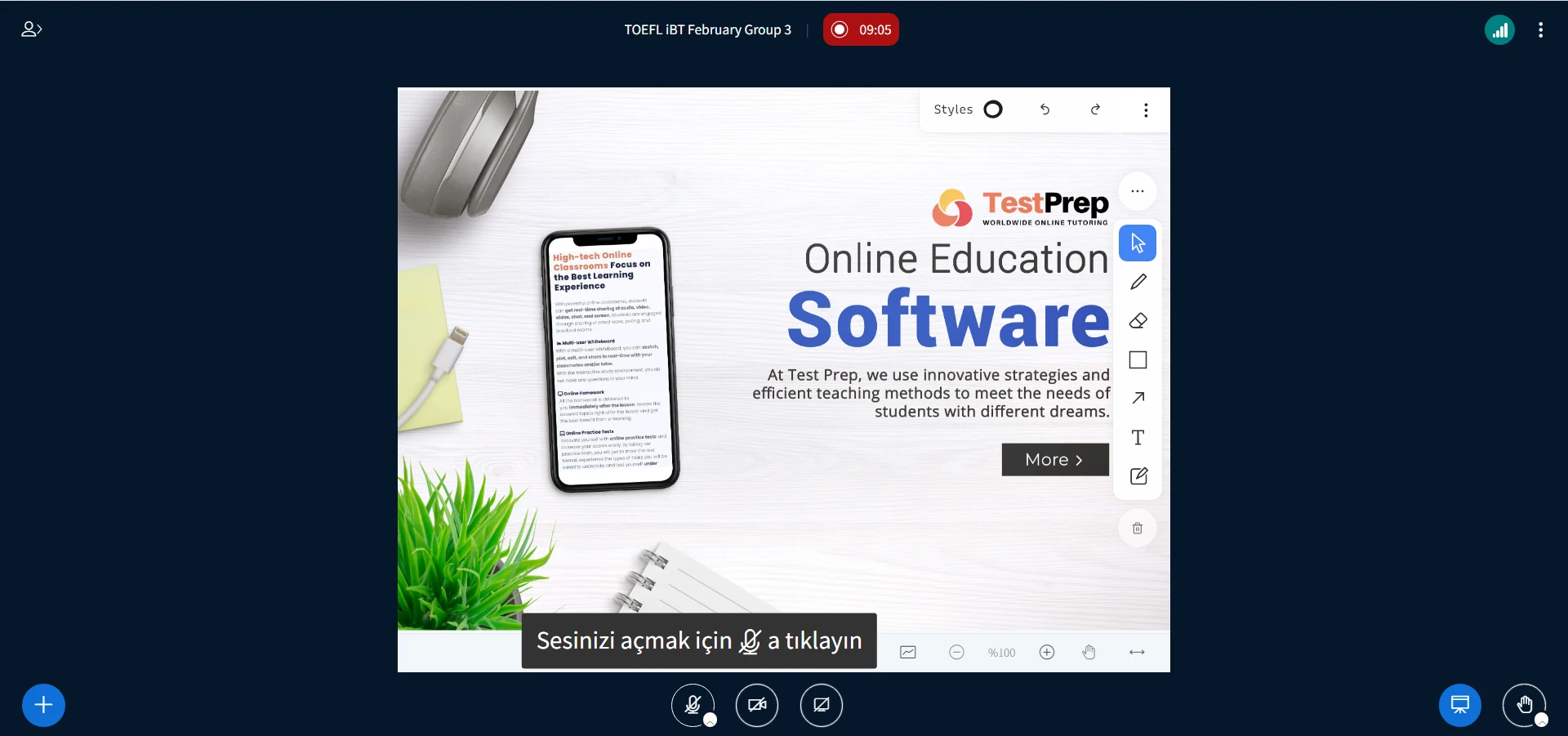
Our online education gives students access to our unrivaled team of international teachers. So students can get the best support for them wherever they are. With the Test Prep Online infrastructure, students can share audio, video, slides, chat and screen in real time. From drawing graphs to writing chemical equations to the flexibility and responsiveness of online workspaces, students and teachers are allowed to explore in detail together. Thanks to the best TOEFL course, at the end of the online lessons, students not only have a good grasp of effective testing strategies, but also have ample opportunities to practice extensively using the materials covered during the lesson. Thanks to the Online TOEFL Course, you can reach the highest score without wasting time.


TestPrep’s TOEFL Prep Course was rich in practice resources, including comprehensive practice tests and sample questions. These resources played a pivotal role in familiarizing me with the structure and content of the TOEFL exam. The practice tests provided an accurate simulation of the actual exam experience, enabling me to develop familiarity with the timing and pacing required. The detailed performance analysis and constructive feedback provided after each practice test were instrumental in tracking my progress and fine-tuning my preparation.
I was particularly impressed by the emphasis placed on each language skill essential for success in the TOEFL exam. The course provided targeted strategies and engaging practice exercises for reading, listening, speaking, and writing. The instructors offered invaluable guidance on effective reading comprehension techniques, active listening skills, speaking fluency, and coherent writing structures. These skills not only helped me excel in the TOEFL exam but also proved invaluable in my academic and professional pursuits.
Moreover, TestPrep’s course fostered an interactive and dynamic learning environment. Through group discussions, speaking exercises, and collaborative activities, I had ample opportunities to practice and enhance my English language skills. The supportive atmosphere created by the instructors and fellow students boosted my confidence and fluency in using English in real-life scenarios.
Thanks to TestPrep’s TOEFL Prep Course, I achieved a remarkable score that exceeded my expectations. The course not only provided me with the knowledge and strategies needed to succeed in the TOEFL exam but also equipped me with the confidence and proficiency to communicate effectively in English. I now feel well-prepared to pursue my academic goals and engage confidently in English-speaking environments.
I wholeheartedly recommend TestPrep’s TOEFL Prep Course to any student seeking to excel in the exam. With its comprehensive curriculum, expert instructors, realistic practice resources, and focus on all language skills, TestPrep provides the ideal choice for TOEFL preparation. Trust me; you will receive the guidance and support necessary to achieve your desired score.
Thank you, TestPrep, for your outstanding TOEFL Prep Course. Your commitment to student success and the quality of your program have been instrumental in helping me reach my goals.
Upon enrolling in TestPrep’s TOEFL Prep Course, I immediately recognized the value of my decision. The course was meticulously designed, offering a comprehensive and structured approach to covering all sections of the TOEFL exam. The study materials provided were of outstanding quality, presenting clear explanations, relevant examples, and effective strategies that proved instrumental in improving my English language skills.
An aspect that truly impressed me was the expertise and dedication exhibited by the instructors. Their profound knowledge of teaching English as a second language and their deep understanding of the TOEFL exam format and requirements were evident throughout the course. Their unwavering passion for teaching and commitment to student success shone through as they provided invaluable guidance, promptly addressing my concerns, and offering personalized feedback that helped me identify my strengths and areas for improvement.
I recently completed one on one online private tutoring for the TOEFL through TestPrep. It was an extremely invaluable experience. My tutor was able to isolate my issues and work through them with me. I would also recommend the live and interactive online tutoring interface that TestPrep has established (especially for those like me who do not reside in Turkey). I think it works as well as face-to-face tutoring. A fantastic experience overall.